


Category: Plant-based ingredients / Dietary fiber
Reading time: 6 minutes
Low-GI eating has moved from fitness forums into mainstream product development. Brands are reformulating with whole grains, low-sugar fruit and minimally processed bases to flatten post-meal glucose curves. But there is a blind spot that shows up again and again in formulation briefs: a low-GI product is not automatically a high-fiber product.
When formulators cut sugar, refined starch and total bulk, dietary fiber often leaves the recipe along with them. The result is a product that scores well on glycemic metrics and poorly on the one thing gut health actually depends on — fermentable and bulking substrate reaching the colon.
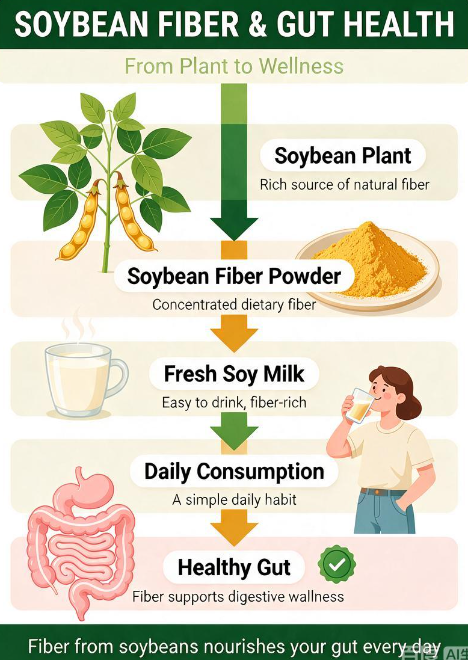
This is where soy fiber powder has earned a place in the ingredient list. Not as a niche supplement, but as a cost-effective, label-friendly fiber source that fits beverages, dairy alternatives, bakery and bars.
1. The fiber gap is real, and low-GI diets can widen it
China’s Dietary Guidelines for Chinese Residents (2022) recommend 25–30 g of dietary fiber per day for adults. National dietary surveys consistently report average intake well below that — commonly cited figures sit in the 10–13 g/day range, driven by refined rice and flour, low vegetable intake and more meals eaten outside the home.
The same pattern appears in export markets. WHO guidance points to roughly 25 g/day for adults, and most national guidelines land in the 25–35 g/day band.
Low-GI diets can make this worse in a specific way. A shopper who swaps a pastry for a refined-starch “low-GI” snack, or replaces fruit with a low-sugar protein bar, may reduce sugar load while also reducing fiber load. The glycemic number improves; the substrate for gut bacteria does not.
For product developers, that gap is a formulation opportunity: fiber is the ingredient that closes the loop between a low-GI claim and a genuinely gut-friendly product.
2. What soy fiber powder actually is
Soy fiber is recovered from the okara stream — the insoluble residue left after soy protein and soy milk extraction — and then washed, heat-treated and milled. Low-temperature drying and fine grinding are what separate a food-grade powder from raw okara: they remove the gritty mouthfeel and the “bean residue” off-note that limit okara’s use at meaningful inclusion rates.
Composition varies by grade and process, but the general profile is:
| Parameter | Typical range (confirm against supplier COA) |
|---|---|
| Total dietary fiber | 50–75% (dry basis), grade dependent |
| Insoluble : soluble fiber | Predominantly insoluble, roughly 3:1 to 4:1 |
| Protein | Residual, varies with protein removal step |
| Available carbohydrate | Low |
| Appearance / mesh | Off-white to light cream powder, typically 80–200 mesh |
Two points matter more than the headline fiber number:
It is mostly insoluble fiber. Soy fiber is cellulose- and hemicellulose-rich, which gives it strong water-holding capacity, fecal bulking and stool-softening behaviour. The soluble fraction (pectin-type polysaccharides) is smaller but still relevant for viscosity and fermentation. If a supplier describes soy fiber as a “balanced” soluble/insoluble blend, ask for the actual ratio — the insoluble share usually dominates.
Its available carbohydrate content is very low. This is why soy fiber behaves as a glycemic-neutral ingredient in a formulation: it contributes little to no digestible carbohydrate, so it does not drive a post-meal glucose response the way a starch-based fiber source can. Note the wording carefully — glycemic index is defined for carbohydrate-containing foods and is rarely assigned to a fiber ingredient with negligible available carbohydrate. The supportable claim is the compositional fact, not a GI number.
3. Why formulators choose it over wheat bran or psyllium
| Soy fiber powder | Wheat bran | Psyllium husk | |
|---|---|---|---|
| Fiber type | Mostly insoluble + some soluble | Mostly insoluble | Highly soluble, viscous |
| Mouthfeel at 3–5% | Fine, low grittiness | Coarse, detectable | Gel-forming, thickens fast |
| Water binding | High | Moderate | Very high |
| Sensory risk | Low at moderate dose | Texture and colour impact | Viscosity spike, gel lumps |
| Allergen | Soy (declaration required) | Gluten | None typical |
| Cost position | Mid | Low | High, volatile |
The practical differentiator is tolerance at useful dose. Coarse brans can feel abrasive, and high-dose psyllium brings viscosity and bloating complaints that show up in reviews. A finely milled soy fiber lets a brand reach a meaningful fiber contribution — enough to support a “source of fiber” claim — without the texture penalty.
The trade-off is the allergen. Soy fiber is a soy-derived ingredient; residual protein is reduced but not zero. Products carrying a soy allergen statement must declare it, and soy-allergic consumers should not be the target audience for the claim.
4. Where it fits in the formulation
| Application | Typical inclusion | Function |
|---|---|---|
| RTD beverages, plant milks | 1–3% | Fiber enrichment, body without gum-heavy texture |
| Spoonable & drinking yogurt, fermented plant bases | 1–2% | Syneresis control, creamier body |
| Bakery, whole-grain bread | 3–6% (flour basis) | Water binding, dough yield, fiber claim |
| Cereal bars, energy bars | 5–10% | Bulk, binding, reduced sugar-alcohol load |
| Powdered supplements, meal-replacement sachets | 3–5 g per serving | Fiber dose with neutral taste |
| Meat and seafood analogs | 1–3% | Water retention, juiciness, yield |
Processing notes worth pinning down early in a trial:
- Hydration. Soy fiber absorbs several times its weight in water. Pre-hydrate in the aqueous phase where possible, and adjust added water rather than compensating with gums later.
- Heat. It is stable through typical bake and retort conditions; the constraint is water balance, not thermal degradation.
- Flavour. At 1–3% it is largely neutral in dairy and cereal matrices. Above 5% in a delicate flavour system, expect some cereal-like masking.
- Label. Declare as soybean fiber / soy fiber, plus the soy allergen statement where required.
5. Claim boundaries — read this before writing packaging copy
Fiber is one of the more heavily regulated claim areas, and soy fiber is often marketed with statements that will not survive a regulatory review.
Claims that are supportable, with the right numbers:
- EU (Reg. 1924/2006): ”source of fibre” at ≥3 g/100 g or ≥1.5 g/100 kcal; “high fibre” at ≥6 g/100 g or ≥3 g/100 kcal.
- US: ”good source of fiber” at ≥10% of the 28 g Daily Value (2.8 g per serving); “excellent source” at ≥20%.
- China (GB 28050): fiber source ≥3 g/100 g (solid) or ≥1.5 g/100 mL (liquid); “high” ≥6 g/100 g or ≥3 g/100 mL.
Claims to avoid:
- Any statement that the ingredient treats, prevents or manages a disease — including diabetes, constipation as a condition, or “regulates blood sugar.”
- Individual testimonial efficacy (“I took 10 g daily for two weeks and my digestion improved”) presented as product evidence.
- A specific glycemic index value for a fiber ingredient with negligible available carbohydrate. State the compositional fact instead.
- “Balanced soluble and insoluble fiber” without the ratio in your COA.
Keep the story on mechanism and composition — water-holding, bulking, fermentation substrate, low available carbohydrate — and let your regulatory team sign off on the final label wording for each market.
6. What to ask a soy fiber supplier
A fiber spec sheet that only lists “dietary fiber ≥ X%” is not enough to qualify a source. Request:
- Total, soluble and insoluble dietary fiber — by AOAC method, with the method number stated.
- Available carbohydrate and sugar — this is what underpins any glycemic positioning.
- Residual protein — drives both allergen risk and flavour.
- Moisture, ash, pH, mesh size / particle size distribution.
- Microbiology — total plate count, coliforms, yeast and mould, Salmonella, E. coli.
- Heavy metals and pesticide residues — market dependent.
- Allergen statement and, if you need it, non-GMO documentation for the soybean source.
- Certification status — BRCGS, HACCP, ISO 22000, organic where relevant.
Ask for the ratio in writing. Two suppliers can both quote “60% fiber” and deliver very different functionality depending on how much of that is soluble.
FAQ
Will soy fiber powder cause bloating or gas?
Some individuals experience mild gas when fiber intake rises quickly, particularly if baseline fiber intake is low. The standard approach is to start low — 2–3 g per day — and increase gradually over one to two weeks alongside adequate fluid intake.
Is it suitable for people with a soy allergy?
No. Soy fiber is soy-derived and residual protein carries allergen risk. Soy-allergic consumers should use a different fiber source.
Can it replace vegetables and whole grains?
No. It is a supplement to the diet, not a substitute. Whole foods deliver fiber plus micronutrients, phytochemicals and food matrix effects that an isolated fiber cannot.
How quickly do effects appear?
Fiber’s benefits are cumulative rather than immediate. Most users notice changes in regularity within one to two weeks of consistent intake, but outcomes depend on total diet, fluid intake and individual baseline.
When should it be taken?
Either timing works. Taken 15–30 minutes before a meal it can support satiety; taken in the morning with water it fits an established routine. Consistency matters more than timing.
How much water should be consumed with it?
Roughly 200–300 mL per serving. Fiber that absorbs water without adequate fluid intake can contribute to hard stools rather than relieve them.
Sourcing soy fiber powder
Hebei Abiding Co., Ltd supplies plant-based food ingredients — soy fiber, plant proteins, fruit and vegetable juices and purées, and FD/AD fruit and vegetable products — to food and beverage manufacturers and private-label programmes.
For technical data sheets, COAs and sample requests:
Zhao Yanchun, Sales Manager
sales@hebeiabiding.com
Tel / Fax: 0086-311-85335656 · Mobile: 0086-13582115098
www.hebeiabiding.com
Post time: Nov-02-2026


