


Recent market research shows that sea buckthorn juice has become one of the fastest-growing functional beverage categories in North China, with consumer demand surging 47% in the past two years. While many buyers enjoy its unique tart flavor and nutritional benefits, few are aware of the complete industrial chain that turns wild sea buckthorn berries into a stable, drinkable product on store shelves. This report takes you through the full standardized production workflow that remains largely invisible to end consumers.
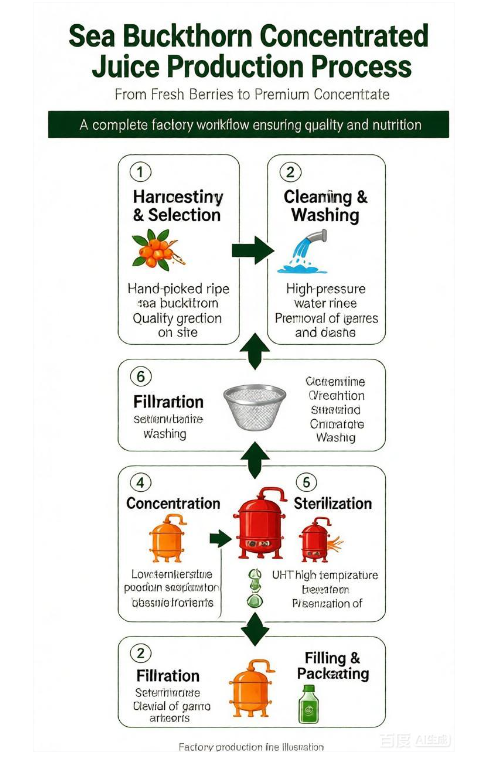
Harvest: Timing and Cold Chain Protection at -5°C
The entire production cycle starts with a strict 15-day harvest window in late autumn. Unlike common fruits, sea buckthorn berries cannot be picked by hand at room temperature — workers must wait for the first frost to naturally freeze the berries on branches, then use specialized vibration equipment to collect them without breaking the delicate fruit skin.
Within 30 minutes of leaving the plantation, all raw materials are loaded into refrigerated trucks that maintain a constant temperature of -5°C. This step prevents oxidation of the berries’ high vitamin C content and stops the natural fermentation process that would alter flavor. Even a one-hour delay at room temperature can reduce final nutritional value by more than 18%, according to production data from major sea buckthorn processing bases in Hebei.
Cold Pressing: No High-Temperature Extraction for Maximum Nutrition
Once arriving at the factory, frozen berries go through automatic screening, high-pressure spray cleaning and impurity removal before entering the cold pressing workshop. The entire juicing process operates below 20°C, avoiding the traditional boiling or steaming methods that damage heat-sensitive active substances.
The extracted raw juice then passes through two separate fine filtration procedures: first removing fruit seeds and peel residue, then filtering out tiny suspended particles that could cause precipitation during long-term storage. This physical treatment ensures the juice retains over 92% of the original sea buckthorn flavonoids, a key nutritional component that most ordinary fruit juice processes lose in large quantities.
Aseptic Filling: Zero Secondary Contamination in Closed Environment
Before filling, the filtered juice undergoes ultra-high temperature instantaneous sterilization — a 3-second treatment at 135°C that kills harmful microorganisms while minimizing damage to flavor and nutrition. This technology is far more precise than traditional long-time pasteurization and has become the industry standard for premium sea buckthorn juice brands.
The entire filling workshop maintains a 100,000-level aseptic standard. All packaging materials are pre-sterilized through ultraviolet and ozone disinfection systems, and the whole filling process is completed in a fully closed pipeline without manual contact. This link directly determines the product’s 12-month shelf life without adding any artificial preservatives.
Laboratory Testing: 21 Indicators Before Products Leave the Factory
Every batch of finished sea buckthorn juice must stay in the factory’s quality control laboratory for 72 hours before being allowed to leave the warehouse. Testing items include nutritional component content, heavy metal residues, microbial limits, pesticide residue screening and sensory evaluation.
Only after all 21 indicators meet national food safety standards can products be labeled, packed and delivered to the market. Even after leaving the factory, enterprises will retain sealed samples of each batch for an additional 6 months to ensure full traceability of every bottle of sea buckthorn juice sold to consumers.
Frequently Asked Questions
- Q: Why can’t sea buckthorn berries be picked at normal temperature?A: Fresh sea buckthorn berries have extremely thin skins and high moisture content. They break easily during manual picking at room temperature, leading to rapid oxidation and fermentation that ruins both flavor and nutrition. Frozen harvesting solves this problem completely.
- Q: Does cold pressing mean no sterilization is needed?A: No. Cold pressing only retains more original nutrients. Natural berries still carry surface microorganisms, so ultra-high temperature instantaneous sterilization is essential to ensure food safety without adding preservatives.
- Q: Why do some sea buckthorn juice products have slight precipitation?A: This is normal natural pulp precipitation. It means the product does not use excessive additives to maintain complete clarity. You can shake the bottle gently before drinking to restore uniform flavor.
- Q: How long can raw sea buckthorn juice be stored after opening?A: It is recommended to finish it within 3 to 5 days and keep it refrigerated below 4°C after opening. Without additional preservatives, the nutrient activity will gradually decrease once exposed to air.
- Q: Is sea buckthorn juice with very sweet taste higher quality?A: No. Natural sea buckthorn itself has a prominent sour taste. Overly sweet products usually add large amounts of sugar or other ingredients, which may reduce the proportion of pure sea buckthorn raw juice.
- Q: Can sea buckthorn production processes completely avoid nutrient loss?A: No process can achieve zero loss. The current full cold chain and low-temperature process system can only maximize the retention rate of active ingredients, which is already the best technical level in the industry.
Post time: Nov-03-2026


