


Hebei Abiding Co., Ltd. Brings Traceable, Standard-Compliant Premium Matcha to Global Markets
As global demand for healthy functional ingredients continues to rise, matcha powder has grown from a traditional Japanese ceremonial beverage to a mainstream staple across North America, Europe, and Asia. To help consumers and bulk buyers distinguish high-quality matcha from low-quality alternatives, this report explores production processes, quality identification, and introduces Hebei Abiding Co., Ltd., a leading Hebei-based tea processor whose matcha products fully comply with Japan and EU-U.S. food safety standards, with a standardized 6-tier grading system for different application scenarios.
Safe, Traceable Origin: Controlled Cultivation Meets Global Safety Standards
Unlike most matcha suppliers that source raw materials from scattered uncertified farms, Hebei Abiding owns and manages all its tea plantations in the pollution-free mountainous regions of northern China, where the cool climate, sufficient rainfall, and fertile uncontaminated soil create ideal growing conditions for high-quality tencha (the raw leaf for matcha). The company implements strict regular testing of soil, irrigation water, and growing environment to monitor for heavy metals and environmental contaminants, eliminating safety risks from the source.
All cultivation follows EU and Japanese agricultural standards, with strict controls on pesticide use, and every batch of raw leaves undergoes third-party testing to ensure residual levels meet the strict maximum residue limit (MRL) requirements of Japan’s Ministry of Health, Labour and Welfare and EU food safety regulations, providing a fully traceable safety record from plantation to finished product.
Differentiated Craftsmanship: Combining Traditional Technique With Modern Precision
Many mass-market matcha producers cut corners to reduce costs: they shorten the shading period before harvest, use mature older leaves, and adopt high-heat grinding that damages nutrients. Hebei Abiding sticks to core traditional processes while upgrading them for modern food safety: 30 days before harvest, all tea bushes for premium matcha are fully shaded to boost chlorophyll and L-theanine content; after hand-harvesting, only the tender top buds and first leaves are selected, and all stems and coarse veins are removed to reduce bitter compounds.
Unlike competitors that use high-speed metal grinding that generates excess heat (which degrades antioxidants and dulls the green color), Hebei Abiding uses slow low-temperature stone grinding for top grades and precision air-cooled grinding for commercial grades, preserving the natural bright green color, umami flavor, and active nutrients. The entire production facility is certified BRC and HACCP, meeting all processing requirements for export to regulated global markets.
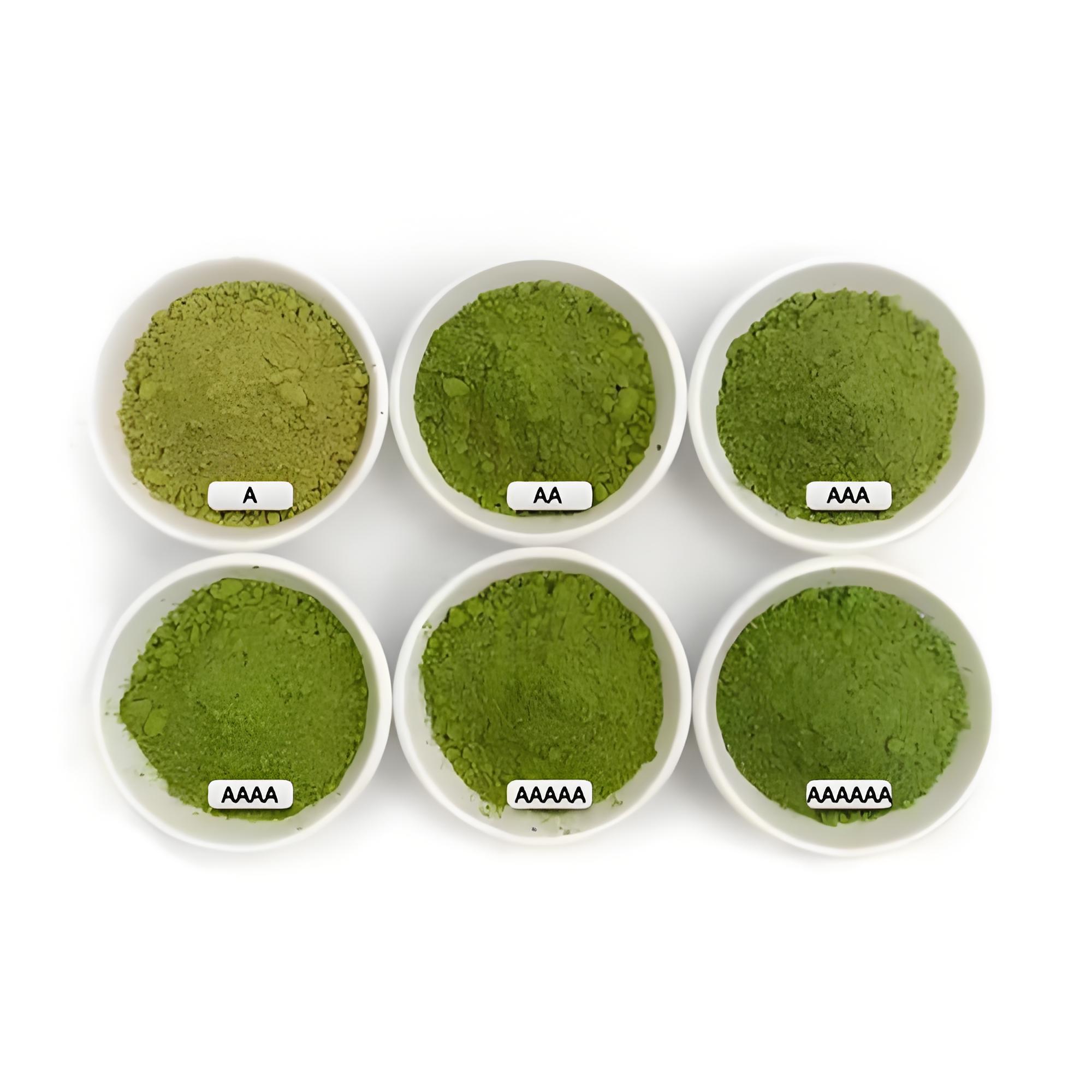
6-Tier Grading by Color & Quality: Matcha for Every Application
Hebei Abiding has established a clear 6-tier grading system based on leaf selection, growing method, and color quality, to meet the needs of different end products:
- Premium Ceremonial Grade: Vivid saturated emerald green, ultra-fine texture, pure umami flavor for traditional tea preparation
- Standard Ceremonial Grade: Bright deep green, balanced sweetness and umami for daily matcha drinking
- Premium Culinary Grade: Rich vibrant green, strong flavor that holds up in dairy, ideal for matcha lattes and premium desserts
- Standard Culinary Grade: Medium bright green, cost-effective for smoothies, ice cream, and baked goods
- Commercial Flavor Grade: Soft natural green, meets all safety standards for flavored matcha products and confectionery
- Industrial Ingredient Grade: Light natural green, designed for mass-produced food supplements and packaged snacks
When identifying matcha quality, the simplest indicator is color: high-quality matcha has a bright saturated green, while low-quality matcha made from mature leaves or poor processing tends to be yellowish, dull olive green, or brownish.
Science-Backed Benefits of Consuming High-Quality Matcha
Compared to steeped green tea, matcha allows consumers to ingest the entire tea leaf, delivering 100% of the plant’s nutrients. High-quality matcha is rich in EGCG (a powerful antioxidant catechin), which supports metabolic health and reduces oxidative stress. L-theanine, a unique amino acid in matcha, promotes calm sustained energy without the jitters caused by coffee, improving focus and mood. The high chlorophyll content in well-made matcha also acts as a natural detoxifier, making it a popular daily wellness choice for health-focused consumers globally.
FAQ
Q1: Do all of Hebei Abiding’s matcha products comply with Japanese and European and American food safety requirements?
A: Yes, every batch of our matcha undergoes third-party testing before export, and meets all MRL, heavy metal, and microbial standards set by Japan, the EU, and the U.S. FDA, with full test reports available for all bulk orders.
Q2: How does Hebei Abiding ensure the safety of its planting base?
A: We conduct quarterly testing of soil and water at all our plantations, control the use of agricultural inputs from seed to harvest, and maintain full traceability for every plot of tea bushes, ensuring no contaminated raw materials enter production.
Q3: What is the biggest difference between Hebei Abiding’s production process and other manufacturers?
A: We do not cut corners on core quality steps: we maintain the full 30-day shading period, select only tender leaves, use low-temperature processing to preserve nutrients and color, and add full safety testing at every stage, which many budget producers do not implement.
Q4: Why does your brand divide matcha into 6 color and quality grades?
A: Different application scenarios have different requirements for color, flavor, and cost. A 6-tier system allows our customers to choose the most suitable grade for their product, from premium ceremonial tea to mass-produced snacks, without paying for unnecessary quality levels.
Q5: How can consumers identify good quality matcha from its color?
A: Bright, saturated, natural green is a sign of high-quality young shaded leaves. Dull, yellowish, or brownish green usually means the matcha is made from old leaves, has poor processing, or has been stored too long and oxidized.
Q6: What are the core health benefits of regular consumption of high-quality matcha?
A: It provides sustained calm energy, rich antioxidants to support metabolism, natural chlorophyll for detoxification, and L-theanine to improve focus and mood, making it a healthy alternative to coffee and sugary drinks.
Post time: Jun-11-2026


