


Why Did Global Tomato Processing Production Hit the Brakes?
In early 2026, data from the World Processing Tomato Council (WPTC) revealed a stark reality: global processed tomato production plummeted to approximately 40.29 million metric tons in 2025, marking an 11.5% to 12% drop from 2024′s 45.8 million metric tons. This significant decline translates to over one ton lost for every ten tons of ketchup raw material produced worldwide, sending shockwaves through the industry.
Who’s Cutting Production? Who’s Holding On?
United States: Voluntary Contraction in the “World’s Tomato Bowl”
As the world’s largest processed tomato producer, the U.S. saw its California Central Valley—dubbed the “World’s Tomato Bowl”—contract dramatically in 2025. Contracted planting area shrank to 205,000 acres, the lowest level since 1972, while total production fell to around 10.3 million metric tons, the lowest since 2006. Notably, this wasn’t due to poor yields—per-acre output actually rose 10% to 55 tons per acre—but a deliberate reduction in planting area. High inventory levels and depressed prices led processors to slash farmer contracts, eroding growers’ enthusiasm for expansion.
European Union: A Tale of Two Extremes
The EU, the world’s second-largest producer, experienced a mixed performance. Italy bucked the trend with a 6% increase, leveraging its high-end product portfolio—including tomato puree and peeled whole tomatoes—that commands premium prices in Western supermarkets. Spain, however, suffered a devastating 22% drop in production. Early spring rains delayed planting, followed by a summer heatwave that destroyed fruit set, leaving farmers helpless as both yield and quality plummeted.
China: A Correction, Not a Collapse
China’s situation requires nuanced interpretation. WPTC data shows its 2025 processed tomato production nosedived from 10.45 million metric tons in 2024 to approximately 4.9 million metric tons, a 53% decline that exceeded Spain’s drop. However, this “collapse” was largely a correction from 2024′s record-high output, which far outstripped normal market demand. The 2025 contraction reflects an active industry adjustment to digest excess inventory and restore market balance, rather than a long-term decline. WPTC predicts China’s production will rebound to 6-7 million metric tons in 2026, with planting area in Xinjiang set to surge 160% from 2025′s low.
Why Can China Expand Against the Tide?
Cost Control: Mechanization as a Competitive Edge
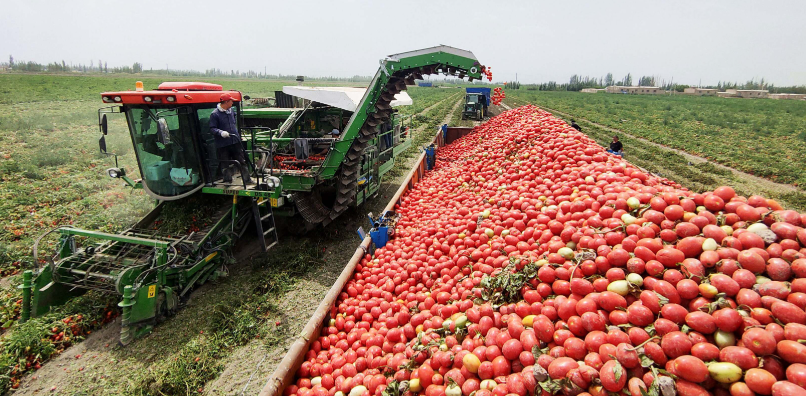
Xinjiang, China’s core processed tomato region, boasts a complete industrial chain from breeding to sales, with over 99% mechanization in sowing and harvesting. Large-scale harvesters replace dozens of manual laborers daily, significantly reducing production costs compared to labor-intensive regions.
Technology-Driven: Full Industry Chain Integration
Chinese companies control the entire value chain—from seeds and planting to processing and sales. Enterprises like Guannong Co., Ltd. saw their 200,000-ton tomato product project reach full capacity in late 2024, coinciding with tight global supply and driving over 30% growth in export orders. This alignment of capacity and demand stems from the industry’s robust infrastructure, not luck.
Market Diversification: Reducing Reliance on Single Markets
China has shifted from relying on Western markets for 70-80% of its tomato paste exports to a diversified portfolio including Russia, Central Asia, the Middle East, and Africa. This “eggs in multiple baskets” strategy insulates the industry from regional market fluctuations.
What Does Global Production Reduction Mean for Chinese Enterprises?
Short-Term Window of Opportunity
With global inventory dwindling and prices rebounding, Chinese enterprises with stable supply capabilities are attracting international buyers. Industry analysts predict a 3-4 year upward cycle for processed tomatoes, promising improved profitability for companies with reliable quality and sufficient capacity.
Long-Term Challenges: From Quantity to Quality
However, this isn’t a “free lunch.” International buyers increasingly prioritize supply chain stability and predictability amid trade tensions and climate uncertainty. Chinese enterprises must move beyond volume competition to focus on quality, technology, and brand building to avoid being marginalized by low-cost producers or outcompeted by high-end brands.
Future: Opportunities and Challenges Ahead
The global tomato processing industry is undergoing a profound restructuring. While China’s short-term production rebound offers immediate benefits, the long-term path requires upgrading product quality, enhancing technological innovation, and strengthening brand competitiveness. The baton of global tomato processing may be passing to China, but success will depend on whether the industry can transform from a “world factory” to a “global leader in value creation.”
Post time: May-20-2026


