


In June 2026, Europe was sweltering with extreme heat.
According to Xinhua News Agency, Agence France-Presse estimated based on weather forecasts and EU Joint Research Centre population data that on June 25, at least 101 million people in Europe were exposed to temperatures above 35°C, with 50 million people affected in France alone. Per the World Meteorological Organization’s reference standards, a heatwave is defined as maximum daily temperature exceeding 32°C lasting for 3 consecutive days or more.
Data from the French Ministry of Agriculture shows that southern France’s tomato-producing regions suffered losses of up to 80%. A GuardianTV report vividly described the situation as “Tomatoes cook on the vine”.
Why was France the most severely affected country in Europe? The global average temperature has already risen by about 1.4°C compared to pre-industrial levels, while Europe’s overall warming has reached approximately 2.4°C. Due to its geographical location and atmospheric circulation patterns, France is more vulnerable to the impact of extreme warm air currents than the UK and Germany. Extreme heatwaves have become a normalized phenomenon in France, arriving earlier and lasting longer each year. Back in 2003, a heatwave in France killed over 14,000 people; in 2026, the heat claimed not only human lives but also crops.
The extreme heat in southern France is far more severe than ordinary “water deficit”. Temperatures consistently exceeding 40°C for multiple days act directly on the fruits themselves, leading to a nearly 30% reduction in corn yields, hundreds of thousands of poultry deaths in France, and a 30%-40% drop in milk production due to heat stress in dairy cows. The entire agricultural sector is “running a fever”.
This heatwave also sparked a political debate over air conditioning in France. The far-right framed air conditioning as a livelihood necessity, while environmentalists emphasized that air conditioning would exacerbate the heat island effect. The reality is that France’s air conditioning penetration rate is less than 10%, far lower than that of neighboring Spain and Italy. In just one week, Carrefour sold at least 30,000 air conditioners and electric fans, and Amazon’s sales of air conditioners and electric fans in France nearly doubled compared to the same period last week.
Back to the tomato industry: how large is France’s tomato processing industry? According to industry forecasts, France’s tomato output in 2026 is expected to reach 494,900 tons, with a planting area of about 2,736 hectares. In April, domestic prices were 34% higher than the 2025 level and 41% higher than the 2021-2025 average. Production cuts have already been directly reflected in prices.
France’s problems are not confined within its borders. As a major agricultural power in the EU, France’s tomato production cut has directly increased delivery pressure on other major producing regions such as Italy and Spain. Quotations for tomato ketchup in the European spot market have already felt supply-side pressure, so short-term price increases are being transmitted to global buyers.
Xinjiang’s “Heat Dome” and the Uncertainty in Inner Mongolia
While Europe is grappling with the tomato crisis, the eyes of global tomato industry players are simultaneously turning to the East. In early July 2026, the Xinjiang Basin in China was hit by a rare “heat dome” extreme weather event.
What is a heat dome? In simple terms, it refers to a stable warm high-pressure system forming at high altitude, acting like a completely sealed thick pot lid fastened over northern China. This “lid” has two fatal characteristics: first, it traps ground heat, preventing hot air from escaping to the upper atmosphere and forcing it to accumulate near the surface; second, it blocks cold air from outside, keeping cool winds out and hot air trapped inside.
Official notifications from the Xinjiang Meteorological Observatory show that in early July, the entire Turpan region remained steadily above 40°C for multiple consecutive days, with a measured maximum temperature of 49°C on July 3, and some local areas expected to approach 50°C, breaking the meteorological extreme for the same period. In Hami, Bayangol and other regions, surface temperatures exceeded 65°C.
What is more alarming is that this “lid” is not stationary. The heat dome is steadily spreading eastward. According to the forecast from the China Meteorological Administration on July 4, the high-temperature belt has covered Gansu and western Inner Mongolia, and then invaded North China and Huanghuai regions. In southern Beijing, Tianjin, central-southern Hebei, northern Henan and western Shandong, the maximum daytime temperature is soaring to 38°C to 40°C.
So, can Xinjiang’s tomato crops survive this year? We need to analyze this from two dimensions: “planting patterns” and “geographical climate”.
Open-field Planting vs. Greenhouse Planting
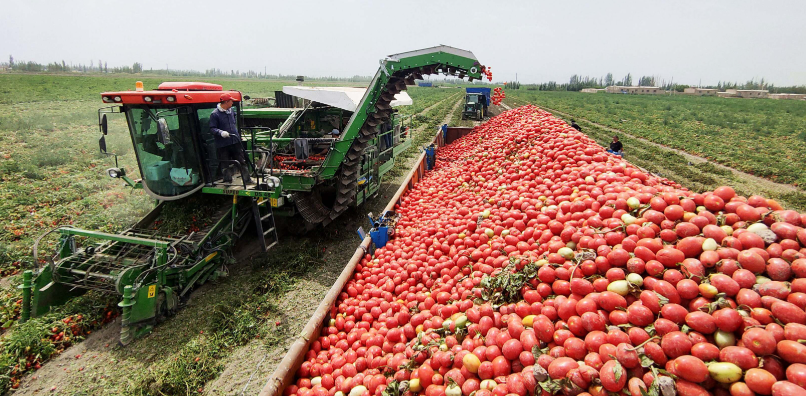
100% of Xinjiang’s processing tomatoes are grown in open fields. The open and ventilated conditions avoid the “stuffy roasting” effect in greenhouses. The most severely affected areas in France were those greenhouses lacking advanced environmental control equipment, where internal temperatures could surge far above the outdoor level. Xinjiang’s tomatoes grow in open fields, where at least wind can blow through.
The Confidence of Tianshan Mountain Snowmelt Irrigation
The lifeblood of Xinjiang’s tomatoes lies in the snowmelt water from the Tianshan Mountains. Although high temperatures increase evaporation, they also accelerate the melting of alpine ice and snow, which in turn ensures a stable water supply. Combined with the widely popularized “drip irrigation under plastic film + integrated water and fertilizer management” technology in Xinjiang, the water supply to the root system can still be precisely guaranteed.
The Last Line of Defense: Diurnal Temperature Difference
The synthesis of lycopene requires suitable nighttime temperatures. Xinjiang’s unique advantage lies in its well-known climate feature: “wearing a leather jacket in the morning and a gauze at noon”. Even if the daytime temperature exceeds 40°C, as long as the nighttime temperature drops to around 20°C, the plants can get a chance to recover.
In 2025, the planting area of processing tomatoes in Xinjiang reached 520,000 mu, with an output of 4.8 million tons. The overall mechanization rate was as high as 99%, with both sowing and harvesting mechanization rates exceeding 98.5%. Xinjiang has more than 70 processing enterprises, forming a complete industrial chain system covering breeding, planting, processing and sales. The vice president of the Xinjiang Tomato Industry Association introduced that the national processing tomato planting area this year is 1.6 million mu, of which 1.35 million mu is in Xinjiang, accounting for more than 84% of the country’s total.
In Changji Prefecture and Heshuo County in Xinjiang, growers reported that “the overall growth of tomato flowering and fruit setting this year is balanced”, with an estimated yield of 9 tons per mu. Growers in Shawan City also said that mid-maturing varieties are expected to be harvested in early August, with a yield of about 9 tons per mu.
Based on multiple news sources, the short-term heatwave in early July has relatively limited substantive impact on the reduction of Xinjiang’s processing tomato production. However, high temperatures will indeed accelerate fruit ripening, which may lead to an excessively concentrated harvest period, putting huge daily processing capacity pressure on downstream processing plants, resulting in queuing.
Post time: Jul-10-2026


