


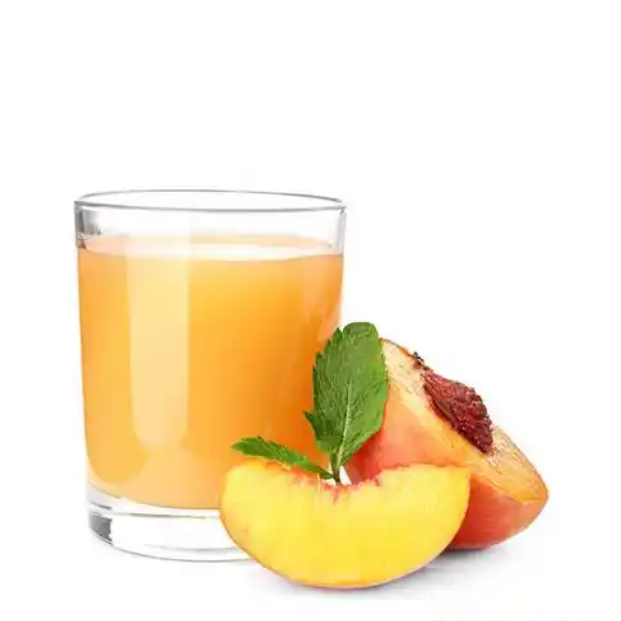
Concentrated peach juice production is a standardized manufacturing process that transforms fresh peaches into high-soluble-solids finished products. Its core goal is to maximally retain the natural flavor, color and nutrition of fresh peaches. The final product typically reaches 65%~70% soluble solids, and is widely applied in beverage blending, dairy products, baking and other fields.
1. Raw Material Pretreatment: From Fresh Fruits to Color-protected Pulp
This is the starting point to guarantee the basic quality of the finished product, which directly determines the subsequent flavor and color stability.
- Fruit Selection and Cleaning: Select fresh peaches with 80%~90% maturity, no pests and diseases, and harmonious sugar-acid ratio, remove rotten and defective fruits. Rinse with clean water spray; for peaches with dense fuzz, brush cleaning can be used. If necessary, food-grade disinfectant can be used for surface disinfection, then rinse off residues thoroughly.
- Pitting and Crushing: Separate peach pits with a mechanical pitter, crush the pulp into uniform pulp with a particle size of 2~3mm. Excessively large particles should be avoided to prevent negative impacts on subsequent juice yield.
- Color Protection Treatment: Add 0.05%~0.1% vitamin C or an appropriate amount of citric acid synchronously during crushing to inhibit enzymatic browning, prevent the peach pulp from oxidative discoloration, and ensure the final finished product has a bright golden color.
2. Juicing and Clarification: Improve Juice Yield and Product Stability
This stage determines the juice extraction efficiency, light transmittance of the concentrated juice and anti-precipitation ability during shelf life.
- Juice Extraction: Use a screw press or airbag press to process the peach pulp, achieving a juice yield of over 70%. A small amount of pulp enzyme can be added before juicing to assist in decomposing pectin and further improve juice extraction efficiency.
- Rough Filtration and Residue Removal: Filter the extracted peach juice with a 60~100 mesh filter screen to remove crude fiber and large granular pulp debris, obtaining initially clarified crude peach juice.
- Enzymatic Clarification: Add pectinase (0.0125%~0.02%) + a small amount of amylase to the crude peach juice, and perform enzymatic hydrolysis at 50~55℃ for 1~3 hours to completely decompose macromolecular pectin in the juice, avoiding stratification and precipitation during subsequent storage.
- Fine Filtration and Purification: Adopt the combined process of plate-and-frame filtration and ultrafiltration membrane (pore size 0.5~0.8μm) to fully intercept residual colloids, heteroproteins and fine suspended solids, finally obtaining clear juice with high light transmittance and strong stability.
3. Concentration Process: Core Technical Link
Two mainstream processes are available for selection according to product positioning, with the core principle of avoiding high temperature damage to heat-sensitive flavor substances.
- Vacuum Low-temperature Concentration (Mainstream General Process): Evaporate and dehydrate under reduced pressure at 50~60℃ with a vacuum degree of 0.08~0.095MPa, increasing the soluble solids of peach juice from the initial 10%~12% to 65%~70%. This process greatly reduces the destruction of peach aroma by high temperature and lowers subsequent storage and transportation costs.
- Normal-temperature Membrane Concentration (High-end Product Process): Use nanofiltration membrane for physical dehydration at normal temperature of 25~35℃, with no phase change in the whole process. The retention rate of flavor substances and vitamins can reach more than 98%, almost no “cooked flavor”, and the energy consumption is lower than that of traditional evaporation concentration. It is suitable for producing high value-added high-end concentrated peach juice.
- Aroma Recovery Optimization: High-end production lines are usually equipped with a volatile aromatic substance condensation recovery device, which condenses and collects the peach aroma escaped during the concentration process, and then adds it back to the finished juice to maximally restore the natural aroma of fresh peaches.
4. Blending and Degassing: Optimize Taste and Quality
After adjusting the sugar and acidity to the target values according to product standards, perform vacuum decompression degassing to remove dissolved oxygen in the juice, reduce oxidative discoloration and flavor deterioration during subsequent storage, and avoid foaming during filling that affects the sealing effect.
5. Sterilization and Filling: Ensure Safety and Long Shelf Life
- Sterilization Treatment: Prioritize UHT ultra-high temperature instantaneous sterilization, maintain for several seconds at 110~120℃, or adopt pasteurization at 95℃ for 30 seconds, which can not only completely kill microorganisms, but also minimize the damage to flavor and nutrition.
- Aseptic Filling: After sterilization, quickly cool to normal temperature, fill the concentrated juice into light-proof and sealed food-grade containers in an aseptic environment. The finished product can be stored for a long time at 0~5℃ low temperature with stable quality and no easy deterioration.
Post time: Oct-16-2026


