


A procurement-oriented guide for overseas formulators and brand owners evaluating Chinese soy milk powder as a functional ingredient — including the specification questions that decide whether a trial batch succeeds or fails.
—
The positioning problem
Instant soy milk powder has spent thirty years in a single box: a cheap, shelf-stable beverage base, sold in sachets, reconstituted with hot water. That framing has kept it out of the conversations where it belongs — texture systems, protein cost engineering, clean-label reformulation.
The ingredient itself is more capable than its packaging suggests. It is a spray-dried, heat-treated soybean product with a protein content in the same order as wheat flour’s, a fat fraction that behaves as an emulsifier, and a flavour profile that — when the process is right — reads as creamy rather than beany.
But “more capable” is not the same as “drop-in replacement.” The gap between a good trial and a failed one is almost always specification, not concept. This guide covers both: where the ingredient creates real value, and what to verify before you commit a production run.
—
1. What the product actually is (and the specs that matter)
The category is not homogenous. “Soy milk powder” on a Chinese supplier’s price list can mean three quite different materials:

Confirm these on the certificate of analysis, not on the product page:
- Protein and fat (as-is, and dry basis) — the two numbers that decide both your nutrition panel and your cost model.
- Moisture — typically ≤5%. Above that, caking and microbial risk climb quickly.
- Dispersibility / solubility — instant agglomerated grades are usually specified above 95%. Ask how it was measured (sediment test vs. dispersion index); the two are not interchangeable.
- Urease activity or trypsin inhibitor — the marker that heat treatment actually inactivated anti-nutritional factors. A “negative urease” result is the line item to insist on.
- Fatty flavour / lipoxygenase control — ask whether the line uses hot grinding or pre-grind enzyme deactivation. This single process choice determines whether you get “creamy” or “green bean.”
- Microbiology, and whether the powder is packed as a ready-to-eat material — critical if you plan cold-mix applications with no downstream kill step.
A buyer who asks only for “protein 20%, price per ton” will get a compliant answer to the wrong question.
—
2. Baking: the real substitution maths
The claim that soy milk powder “raises protein by 30%” is not a property of the ingredient. It is a property of the arithmetic — and the arithmetic is dilution, not fortification.
Take a bread flour at 12% protein and a soy milk powder at 20% protein:
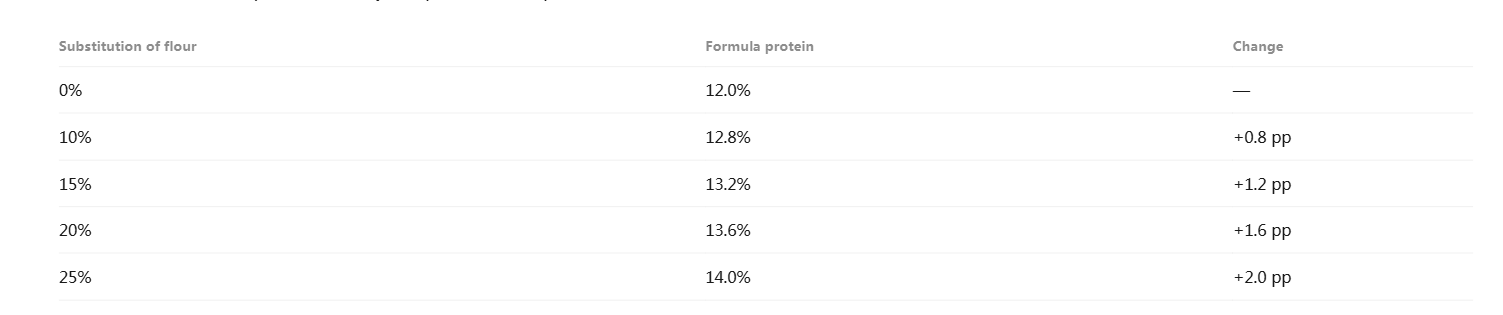
So a 20% swap delivers roughly 1.5–2 percentage points — a gain of about 13–17% in relative terms, not 30%. That is still commercially meaningful: 1.6 pp is often enough to move a product across a “source of protein” threshold in the EU, or to support a “good source” claim in the US. But you should model it with your own numbers rather than quoting a supplier’s headline figure.
The functional case is stronger than the nutrition case:- Crumb and staling. Soy milk powder holds roughly two to three times its weight in water, and that bound water stays put during bake and storage. At 10–20% substitution, bakers typically report a softer crumb and slower firming over the first 3–7 days — comparable in direction to what you would get from added fat or an emulsifier, but without the label implications.
- The process adjustments you will need. Gluten is being diluted at the same time as protein is being added. Above roughly 15–20% substitution, expect reduced oven spring and a tighter crumb; plan for 0.5–1% vital wheat gluten and an increase in hydration of 3–6% of flour weight. Soy protein also browns faster in the crust, so a 5–10 °C reduction in top heat is often needed.
- Flavour carry. A properly deodorised powder adds a soft, cooked-bean creaminess at 10–25% of the flour fraction. Above about 30% of total dry ingredients, most tasters begin to identify the soy note explicitly — which may be fine for a soy-forward concept and wrong for a neutral white pan bread.
For vegan buttercream and tart fillings , the powder’s emulsifying fat fraction is genuinely useful: hydrated at 1:3 with water or plant milk, then whipped with coconut cream, it produces a filling that holds shape at ambient display temperature better than a coconut-cream-only system, which tends to slump. Start at 5–8% of the filling weight; higher loadings read as gritty once the fat phase separates.
—
3. Meal replacement: the cost question nobody asks correctly
This is where most supplier documentation is actively misleading, and where a careful buyer gains an advantage.
Soy milk powder is cheaper per kilogram than soy protein isolate. It is not necessarily cheaper per gram of protein — because it delivers roughly a quarter of the protein density.
The breakeven is straightforward:
> Soy milk powder wins on protein cost only when its price per kg is below about 22% of the isolate price per kg (at 20% vs 90% protein density: 20/90 ≈ 0.22).
Run that check before you accept a 20–30% “cost saving” claim. In many markets the two land close together on a per-gram-protein basis — which means the honest reason to use soy milk powder is not raw-material cost at all. It is:
- Ingredient statement and processing story. “Soybean” or “soy milk powder” on a panel reads as a whole food; “soy protein isolate” reads as an industrial fraction. For brands whose positioning depends on that distinction, the powder is worth a premium, not a discount.
- Texture in bar systems. Powders with native fat and fibre bind water and reduce the chalky, drying mouthfeel that high-dose isolates produce in bars and RTD shakes. This is a formulation win, not a cost win.
- Amino acid completeness. Soy protein carries a PDCAAS of 1.0 in isolate form; the powder is lower on a protein basis because of the carbohydrate and fibre fraction, but it still supplies the full amino acid pattern — which single-source pea systems do not, and which is why pea-heavy products usually require blending or added methionine.
- Satiety and fibre signalling. The powder contributes some native fibre and isoflavones. Be careful here: most commercial soy milk powder has had the okara removed, so the fibre contribution is modest — typically low single digits as a percentage of the powder. Do not build a “high fibre” claim on this ingredient alone.
Practical starting points for a first trial, at 10–15% of the dry blend:
- Expect viscosity creep in RTD systems within 24–48 hours; the powder’s protein and fibre hydrate slowly. Either pre-hydrate or accept a 20–30 minute hold before filling.
- Check the powder’s own microbial specification before designing a no-cook bar or overnight-oats product. A powder intended for reconstitution and boiling is not automatically suitable for a cold-mix matrix.
- Verify how the protein claim is calculated in your target market before writing copy. In the EU, “source of protein” requires protein to supply at least 12% of energy and “high protein” at least 20%; in the US, “good source” starts at 10% of daily value per reference amount and “high/excellent source” at 20%. A 1.5 pp formula increase may or may not clear the bar, depending on the rest of the recipe.—
4. Light food and cold applications: the segment with the most upside — and the most hidden risk
Café chains, salad concepts and convenience-store own brands have the strongest structural fit for this ingredient, because they need exactly what it provides: creaminess without dairy, protein without a “supplement” flavour, and a binder that does not turn a product hard.
- Smoothie and grain bowls. Hydrated at 1:3 and blended into cold bases, it adds body that survives holding at 4–8 °C for several hours, unlike dairy cream systems that break or thin. It also carries a savoury, umami-adjacent note that lets formulators cut added sugar in dressings by a meaningful margin without the product reading as “missing something.”
- Grab-and-go binding. In puffed rice bites, vegetable crisps and compressed energy bars, the powder’s water-binding plus its native fat fraction produces a coherent bite that stays tender rather than turning glassy — the usual failure mode of high-isolate bar binders.
- No-cook soup and porridge bases. This is the fastest-growing use in Japan and Korea: cold-dispersible soy bases positioned in the 100–200 kcal convenience segment. It works because the powder is genuinely cold-dispersible — but only if the grade is agglomerated and lecithinated for that purpose.
The hidden risk sits underneath all three: cold-mix means no kill step. If your process has no heat treatment after the powder is added, the powder’s own microbial load becomes your finished-product load. Ask for total plate count, Enterobacteriaceae and Salmonella results on the specific lot, confirm the packing environment, and require an unopened-sample retention protocol. This is the single most common reason a promising cold application fails at scale-up, and it is a documentation question, not a formulation one.
—
5. Clean label: what is true, what needs proof
The clean-label advantage is real but narrower than most marketing copy implies. Three claims, sorted by how much work they require:
True with basic verification. A plain soy milk powder has a short ingredient statement — “soybean” or “soy milk powder.” No flavours, colours or preservatives are needed in the base product. This is genuinely useful for brands with a “no additives” promise.
True only with documentation. “Non-GMO” is a supply-chain claim, not a product property. Chinese soybean supply is predominantly domestic non-GM, but the certificate that matters is identity-preserved (IP) documentation tying your lot to non-GM origin, plus the absence of GM material above your market’s labelling threshold (0.9% in the EU). Ask for the IP certificate and the per-lot PCR test, not a marketing statement.
Not a clean-label issue at all — and frequently got wrong. Soy is a declared allergen under US FALCPA, EU Regulation 1169/2011 Annex II and Codex. A two-word ingredient list does not exempt you from allergen labelling and, in some markets, from precautionary statements. Suppliers who present “clean label” as a way around allergen declaration are telling you something about their compliance literacy.
One phrase to retire. “FDA certified” does not exist for food. US market entry rests on facility registration, FSMA preventive controls and, for importers, the FSVP programme. A supplier who claims FDA “certification” is either mis-translating or overstating. Ask instead for: FSSC 22000 or BRCGS certificate with scope and expiry, HACCP plan summary, HALAL and KOSHER certificates with the certifying body named, and confirmation of current FDA facility registration.
If organic is on your roadmap, note that organic soy milk powder requires certified organic beans and a certified organic processing line — a different supply chain from standard product. Do not assume a conventional supplier can switch on request.
—
6. Twelve questions to send a Chinese supplier before the first sample
1. Protein and fat, as-is and dry basis — for the exact grade you are quoting?
2. Is the powder agglomerated/lecithinated for cold dispersion, or standard spray-dried?
3. How is dispersibility measured, and what is the tested value?
4. Urease activity or trypsin inhibitor result on the current lot?
5. Hot grinding or pre-grind enzyme deactivation — and is there a vacuum deodorisation step?
6. Full microbiological panel, including Enterobacteriaceae , on a specific lot number?
7. Packing format (inner liner, nitrogen flush, bag size) and bulk density?
8. Identity-preserved non-GMO documentation available per lot?
9. Which certifications are held, by which body, with what scope and expiry?
10. Minimum order quantity, lead time, and stability data supporting the shelf life you claim?
11. Can you supply 5–10 kg trial samples of two grades for side-by-side bench work?
12. What is your position on applications support — do you have technical staff who can review a formulation?Question 11 matters more than it appears. Comparing a standard grade against a high-protein grade on your own bench, in your own matrix, resolves in two days what a month of correspondence cannot.
—
FAQ
Will it make baked goods taste beany?
A properly deodorised, enzyme-deactivated powder used below roughly 25–30% of the flour fraction typically reads as creamy rather than beany. Above that, the soy note becomes identifiable. The variable that matters is process, not dosage alone — a poorly deodorised powder at 10% will taste more beany than a good one at 20%.
Can it be used in cold formulations without heating?
Yes, if the grade is agglomerated and lecithinated for cold dispersion. Expect slower hydration than in hot water — a 20–30 minute hold, or high-shear pre-hydration, is normal. Confirm the microbial specification first, since a cold process provides no kill step.
How does it compare with soy protein isolate?
Standard instant soy milk powder runs roughly 15–22% protein; high-protein grades reach 30–40%; isolate is above 90%. It cannot substitute 1:1 for isolate in a high-protein product without reformulation. Its advantages are texture, ingredient-statement simplicity and native fat — its cost advantage is per kilogram, not reliably per gram of protein.
What shelf life can I expect in the finished product?
Baked goods and bars typically behave like other plant-flour-containing products — commonly 6–12 months under standard packaging, driven by water activity and the fat phase rather than by the soy powder itself. Full-fat grades carry more rancidity risk than low-fat grades; if you need the longer end of that range, test peroxide value and sensory at 3, 6 and 9 months rather than assuming.
Is it compliant with major international standards?
Leading Chinese manufacturers hold FSSC 22000 or BRCGS, HACCP, HALAL and KOSHER, and maintain FDA facility registration. Note that “FDA certification” is not a real status; the applicable requirements are registration, FSMA preventive controls and FSVP for importers. Verify certificates with the issuing body, not with the supplier’s PDF.
What inclusion rate should a first trial use?
10–15% of the flour or dry-blend weight. At that level you can measure texture and flavour effects without confounding them with gluten dilution or viscosity problems. Increase in 5% steps once you have a baseline.
—
Prepared for formulators and procurement teams evaluating instant soy milk powder. Specification ranges quoted reflect common commercial grades; always confirm against the supplier’s certificate of analysis for the specific lot.
Post time: Nov-10-2026


